(At the end of this page you will find a German translation for convenience only. Am Ende dieser Seite steht die deutsche Gefaelligkeitsuebersetzung.)
INRI INBI JeHoVaH
The Name of God on the Cross
The name of God the Father, Jehovah, is the most important word in the Old Testament. It appears exactly 1860 times in the TORaH. This is the number of God's name 26 times 70. The name does not appear in the New Testament. God wanted to show us that he had now appointed his son Jesus as mediator between himself and humanity. God had already demonstrated this through countless signs and wonders in the life of Jesus.
Even in the death of Jesus, God still left signs. One of these signs was the inscription on the cross at Golgotha. It is not unlikely that this inscription revealed the name of God. This also explains why the Jews wanted to change this inscription.
Jhn 19:19-22
And Pilate wrote a title, and put it on the cross. And the writing was, JESUS OF NAZARETH THE KING OF THE JEWS. - This title then read many of the Jews: for the place where Jesus was crucified was nigh to the city: and it was written in Hebrew, and Greek, and Latin. - Then said the chief priests of the Jews to Pilate, write not, The King of the Jews; but that he said, I am King of the Jews. - Pilate answered, what I have written I have written.
All evangelists mention this, but in a shorter way: Luk 23:38, Mat 27:37, Mar 15:26.
So the prophecy of Jesus was fulfilled from Jhn 8:28: Then said Jesus unto them, when ye have lifted up the Son of man, then shall ye know that I am he, …
Thus, the Jews were shown not only that they had crucified the Son of God, but in a certain sense also the Father.
Jhn 14:9 … he that hath seen me hath seen the Father; …
1 Jhn 2:23 Whosoever denieth the Son, the same hath not the Father.
Most of the Jews did not recognize it until today. But there will be a time when the remnant will recognize him according to Zechariah 12:10: And I will pour upon the house of David, and upon the inhabitants of Jerusalem, the spirit of grace and of supplications: and they shall look upon me whom they have pierced, …
The term Titulus Crucis is the Latin translation of the Koine Greek word titlos (τίτλος) which means inscription. In the Church of Santa Croce in Gerusalemme in Rome is a walnut wood with an inscription, which could have been a part of the original board.
Text of Inscription
This way it could have been written:
English (30 letters):
Jesus the Nazarene the King of Jews
Akronym: JNKJ
German (34 letters):
Jesus der Nazarener der Koenig der Juden
Akronym: JNKJ
Greek (36 letters):
Ιησούς ο Ναζωραίος ο βασιλεύς των Ιουδαίων
ΙΗΣΟΥΣ Ο ΝΑΖΩΡΑΙΟΣ Ο ΒΑΣΙΛΕΥΣ ΤΩΝ ΙΟΥΔΑΙΩΝ
Akronym: ΙΝΒΙ
Latin (26 letters):
iesus nazarenus rex iudaeorum
IESUS NAZARENUS REX IUDAEORUM
Akronym: INRI
Biblical Hebrew (20 letters):
*ישוע הנצרי ומלך היהודים*
Hebrew with pointing:
*יֵשׁוּעַ הַנָּצְרִי וּמֶלֶךְ הַיְהוּדִים*
Transcription into Latin (Tiberian pronunciation):
Yēšūaʿ ha-Nāṣrî ū-Meleḵ ha-Yəhûdîm
A simplified transcription into Latin:
(The Hebrew letter Vav can be transscripted as U or W)
Yesua Ha nasri W melek Ha yehudim
Akronym: JHWH = Jehovah
Modern Hebrew (21 letters):
*ישוע הנוצרי ומלך היהודים*
Hebrew with pointing:
*יֵשׁוּעַ הַנּוֹצְרִי וּמֶלֶךְ הַיְהוּדִים*
Transcription into Latin (Tiberian pronunciation):
Yeshúa ha-Notzrí u-Mélech ha-Yehudím
Akronym: JHWH = Jehovah
End of Text of Inscription
Pictures
This way it could have been seen:


Visual Explanations


Below an inscription at the cross in the Catholic Church St. George, Ulm, Germany. It is a very rare attempt of the artist to reconstruct the original inscription. The Greek and Latin versions are abbreviated and the Hebrew version differs only in one letter. Picture was taken at Pentecost 2024.
Hebrew: * ישוע הנצרי המלך היהודים *
Latin: * Iesus : naz : rex : iudæor *
Greek: * Ιησους : Ναζ : βασ : Ιουδ : *
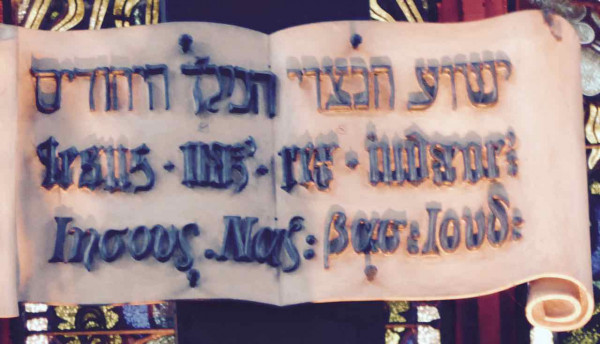
Below an inscription at the cross in the former Catholic Hospitium of the Teutonic Order <Great Holy Cross>, Goslar, Germany, 2026:
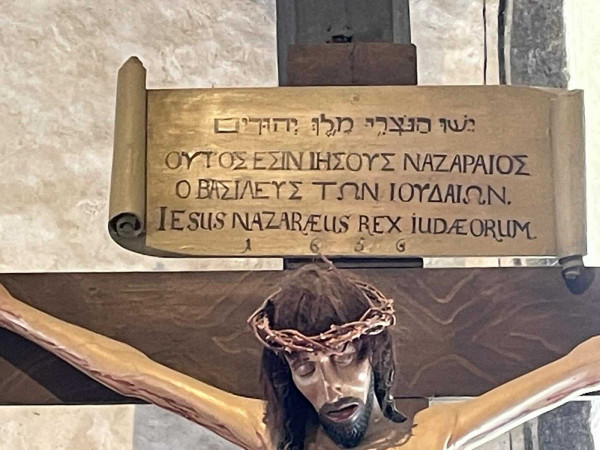
Below an inscription under the cross in the Lutheran City Church, Freudenstadt, Germany, 2026:
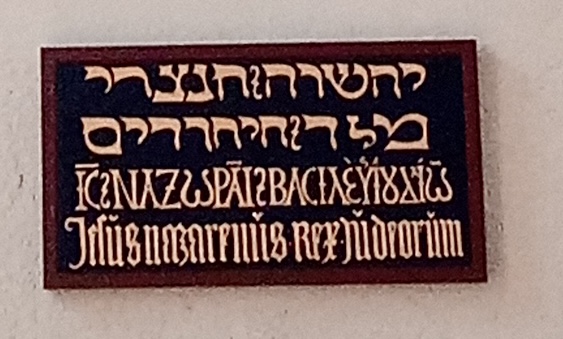
Below an inscription in the chapel of the <Oasis of Peace>, Medjugorje, Bosnia and Herzegovina, 2026:
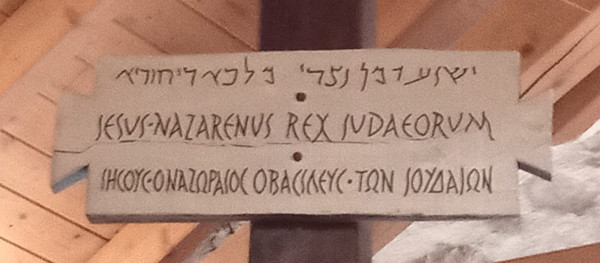
There ist also a full inscription at a cross in the church Saint-Germain l'Auxerrois, Paris, France.
End of English page
INRI INBI JeHoVaH
Der Name Gottes am Kreuz
Der Name Gottes des Vaters Jehovah ist das wichtigste Wort im AT. Es kommt genau 1860 mal vor. Dies ist die Zahl des Namens Gottes 26 mal 70. Im NT kommt der Name nicht vor. Gott wollte damit zeigen, dass er nun seinen Sohn Jesus als Mittler zwischen sich und den Menschen eingesetzt hat. Gott hatte dies schon durch zahllose Zeichen und Wunder im Leben Jesu bewiesen.
Auch in der Kreuzigung Jesu setzte Gott noch Zeichen. Eines dieser Zeichen war die Inschrift am Kreuz von Golgatha. Es ist nicht unwahrscheinlich, dass diese Inschrift den Namen Gottes zeigte. Dann wird es auch verstaendlich, warum die Juden diese Inschrift aendern wollten.
Johannes 19,19-22: Pilatus schrieb eine Ueberschrift und brachte sie am Kreuz an. Die Aufschrift lautete: Jesus von Nazareth, der Koenig der Juden. – Diese Ueberschrift lasen viele Juden, denn die Staette, wo Jesus gekreuzigt wurde, war nahe bei der Stadt. Sie war auf Hebraeisch, Griechisch und Latein geschrieben. – Da sprachen die Hohenpriester der Juden zu Pilatus: Schreibe nicht: Der Koenig der Juden, sondern dass er gesagt hat: Ich bin der Koenig der Juden. – Pilatus antwortete: Was ich geschrieben habe, habe ich geschrieben.
Alle Evangelisten erwaehnen dies, allerdings in kuerzerer Form: Lukas 23,38, Matthaeus 27,37, Markus 15,26. So erfuellte sich die Prophezeiung Jesu aus Johannes 8,28: „Da sprach Jesus zu ihnen: Wenn ihr den Menschensohn erhoeht habt, dann werdet ihr erkennen, dass ich es bin, …“
Den Juden wurde somit nicht nur vor Augen gefuehrt, dass sie den Sohn Gottes gekreuzigt hatten, sondern in gewissem Sinne auch den Vater: 1 Johannes 2,23: Wer den Sohn leugnet, hat auch den Vater nicht. Johannes 14:9 … wer mich gesehen hat, hat den Vater gesehen; …
Die meisten Juden erkannten es damals und bis heute nicht. Doch es wird eine Zeit kommen, in welcher der Ueberrest ihn erkennen wird, gemaess Sacharja 12,10: „Und ich werde ueber das Haus David und ueber die Einwohner Jerusalems den Geist der Gnade und des Flehens ausgiessen; und sie werden auf mich schauen, den sie durchbohrt haben, …“
Der Begriff „Titulus Crucis“ ist die lateinische Uebersetzung des griechischen Wortes „titlos“ (τίτλος) aus der Koine-Sprache, das „Inschrift“ bedeutet. In der Kirche Santa Croce in Gerusalemme in Rom befindet sich ein Walnussholz mit einer Inschrift, welches ein Teil der Originaltafel gewesen sein koennte.
Ende